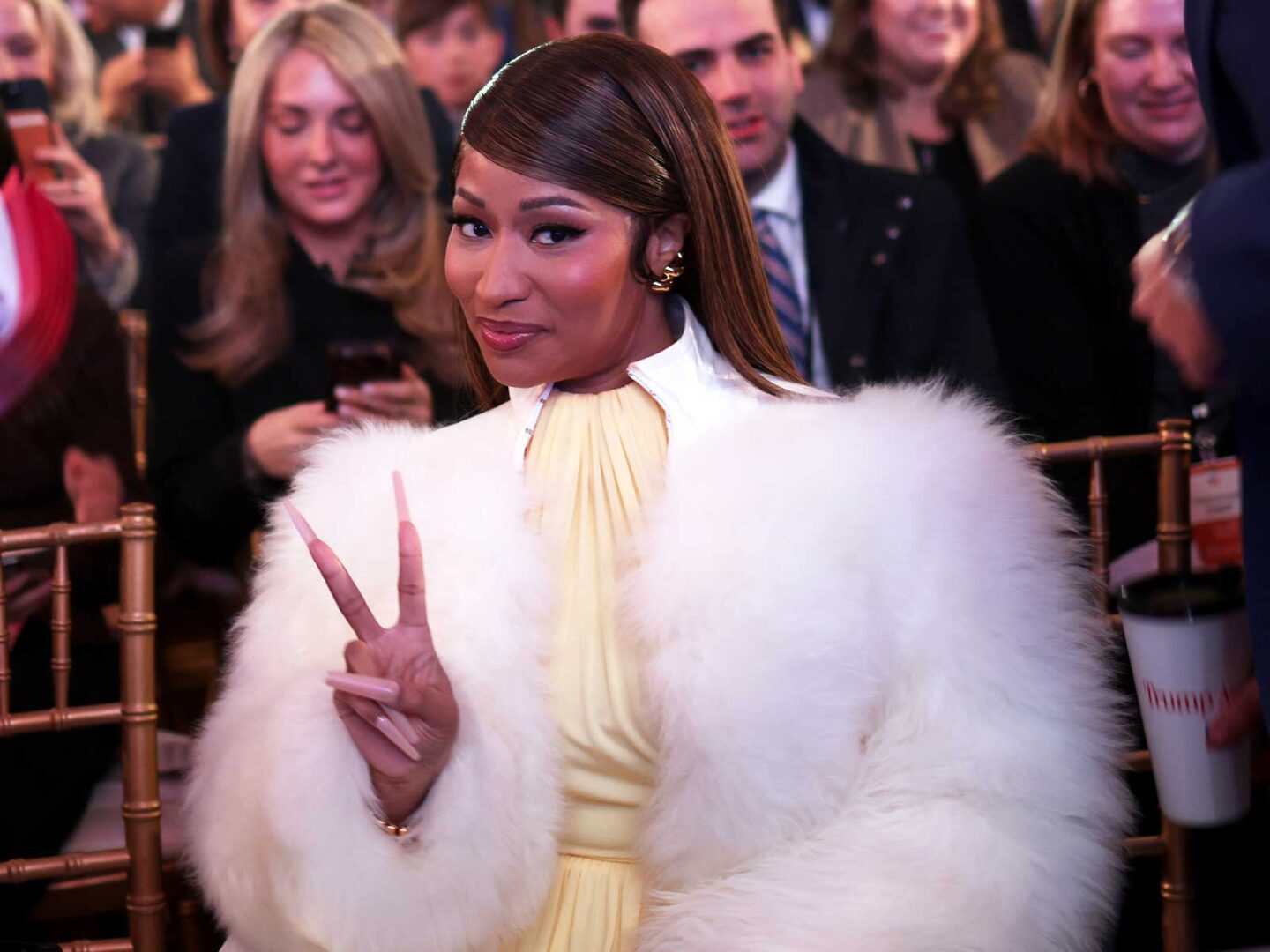
The video lasts just over a minute, but it explains quite well how pop culture works today. This week, Nicki Minaj reappeared in Washington alongside Donald Trump to publicly reaffirm her support for him during an official government event. The rapper described herself as “probably the president’s number one fan,” assured that criticism does not affect her at all, saying “smear campaigns are not going to work,” and concluded with “God protects him.” Trump, standing behind her, smiled as if the script had already been written.
Within hours, the clip had become headlines, memes on Instagram, ironic duets on TikTok, reaction videos on YouTube, and express debates on X that lasted exactly as long as it takes to refresh a scroll. All this was happening while a new wave of violence linked to immigration policies, ICE raids, and allegations of police brutality continued to dominate public conversation. This contrast did not slow down the virality; on the contrary, it accelerated it. The literalness of the discourse, in a system accustomed to irony, proved particularly combustible.
There was no boycott, no withdrawal of music, no awkward silence on the part of the industry. The system did what it does best: absorb the impact and turn it into content. The scandal became format, the outrage turned into humor, and cancellation once again showed its real function in 2026: it acts not as punishment, but as a filter. It does not eliminate figures, it redistributes audiences, it shifts the debate, and it confirms that talking about “banning” today implies continuing to believe in a shared cultural morality that simply no longer organizes contemporary pop culture.
From ‘what’s she doing?’ to ‘oh, okay’
For a long time, Nicki Minaj was seen as a contradictory figure within the progressive mainstream: uncomfortable, unpredictable, but still integrable. After repeating and reinforcing her support for Trump, that interpretation has changed. It is no longer contradiction. It is alignment. And that is where the commotion becomes narrative.
A migrant, a black woman, a global icon for audiences directly affected by the policies she now defends, Nicki creates a dissonance that is interpreted not as artistic provocation, but as a script failure. Moreover, Nicki does not play with ambiguity. She does not talk about “freedom of thought” or “open debate.” She talks about God, individual merit, and personal gratitude.
Memes, reactions, and debates
As is often the case, the internet found the right language first. Memes began circulating, reusing the old code of “if you’re being kidnapped, blink three times” applied to Nicki Minaj. Not as a literal accusation, but as a collective way of saying: this doesn’t fit.
Added to this were reaction videos with long faces and awkward silences, explanatory threads attempting to reconcile biography and discourse, express debates on whether art and politics can be separated (again), and, to top it all off, a petition that circulated months ago on platforms such as Change.org calling for her deportation from the United States for her support of Trump.
Humor operates here as a cultural mechanism of translation. When political discourse no longer fits into existing narrative frameworks, the internet responds with irony.
Pop culture in its post-moral phase
The final question is no longer whether Nicki Minaj should be canceled, but why we continue to expect pop culture to function as a moral judge. In an ecosystem dominated by streaming, hyper-segmentation, and ideologically coherent audiences, scandal rarely destroys value: it redistributes it, reorganizing audiences and shifting the center of attention.
Today, two models coexist without canceling each other out. On the one hand, artists like Bruce Springsteen continue to embody the classic figure of the musician as an ethical conscience. On the other, there are those who understand that conflict is no longer resolved by seeking consensus, but by managing polarization as a form of constant media presence. It is not a battle between right and wrong, but a clear sign that in this era, media impact matters more than public judgment.
Sigue toda la información de HIGHXTAR desde Facebook, Twitter o Instagram