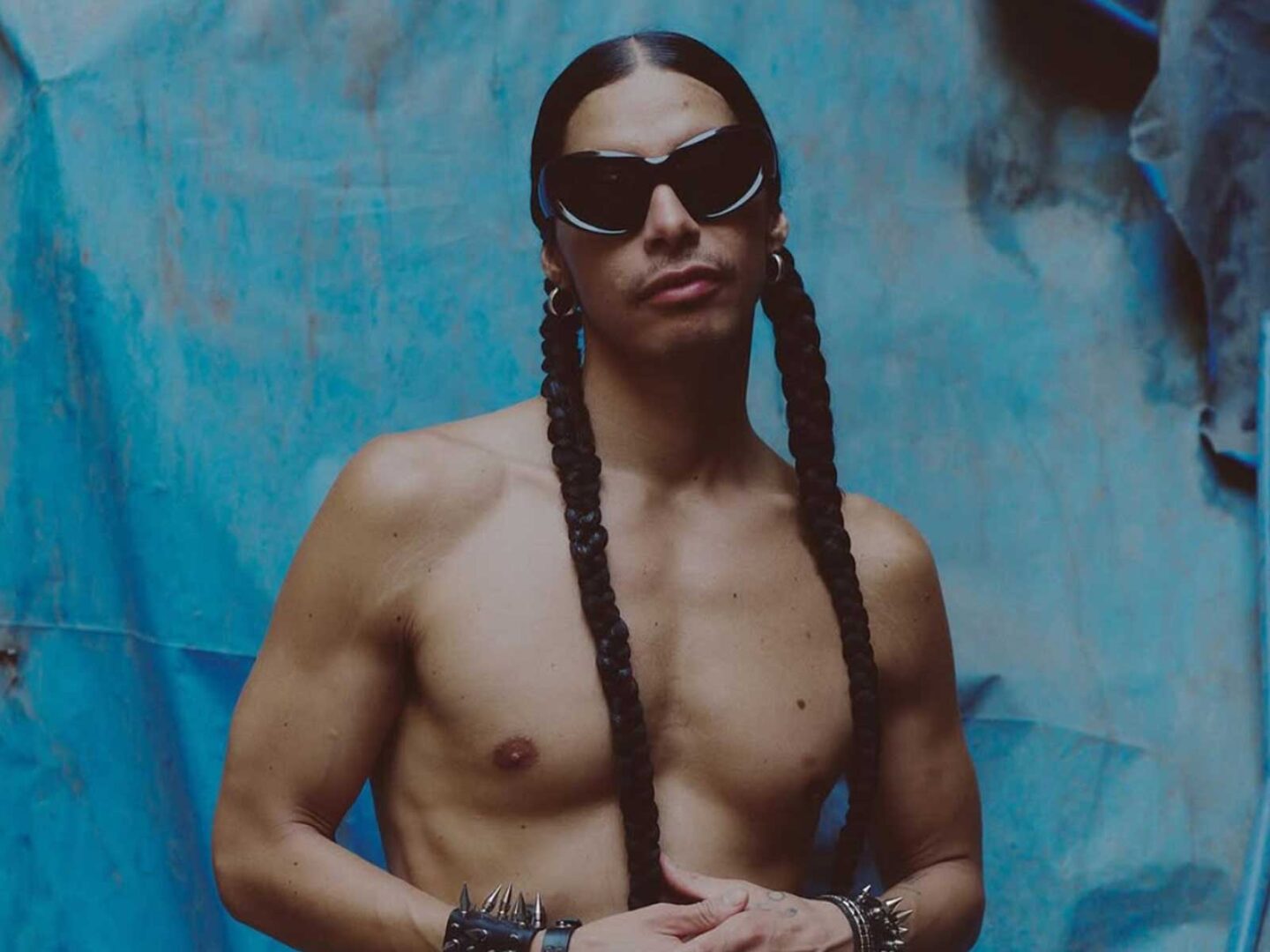
For a time, the name A.Chal circulated quite naturally on the fringes of the global music scene. He wasn’t a ubiquitous figure, but he was visible enough to be recognised as one of the most distinctive emerging voices of his generation. Behind the alias is Alejandro Salazar Pezo, a Peruvian artist raised in Queens, New York, whose work found an audience in the mid-2010s thanks to an unusual combination of atmospheric R&B, introspective sensibility and a deliberately ambiguous aesthetic.
That initial recognition, however, did not translate into conventional consolidation. Quite the opposite: just as his name was beginning to establish itself, his presence began to fade. Releases became fewer and further between, public appearances grew sporadic, and his figure remained suspended in a sort of intermittent memory, as if he had never quite managed to establish himself fully in the spotlight. Today, his return with new music compels us to revisit that journey from a different perspective. Because there are paths that only make sense with the passage of time.
From his earliest works, collected in Ballroom Riots (2013), A. Chal showed a penchant for restrained forms. In a context where urban music was beginning to establish recognisable and easily replicable codes, his approach occupied a space that was too introspective for the more commercial scene, yet too closely tied to the urban scene to fit fully into more orthodox alternative spaces. Far from being resolved, this middle ground became the foundation upon which he built his artistic language.
The highlight of this early phase came with Welcome to Gazi (2016), an album that distilled and amplified his initial artistic vision with tracks such as ‘Round Whippin’’. Later came ON GAZ (2017), which elevated him with tracks like ‘To the Light’, ‘Love N Hennessy’ and collaborations with ASAP NAST on ‘Cuánto’ or the ‘Round Whippin’ remix featuring French Montana. The track ‘000000’ also remains one of his most streamed. That balance between accessibility and strangeness allowed his music to find its own audience, albeit not necessarily a massive one.
However, that initial momentum did not lead to a period of expansion in the conventional sense. Following that initial phase of consolidation, his output began to slow down. Releases became less frequent, public appearances fewer, and his presence on the festival circuit gradually diminished. This hiatus was interpreted at the time as a loss of momentum, but it can also be seen as a retreat from the demands of an industry that penalises any form of discontinuity.
During that period, A.Chal did not disappear completely, but rather shifted his activity to less visible areas. Occasional collaborations, production work and links with other artists formed part of a quieter phase. It is within this context that his relationships with figures such as Rosalía and C. Tangana emerged; artists who, from different perspectives, were also rethinking the relationship between tradition, identity and contemporaneity. The use of English and Spanish in his tracks has also led him to collaborate with international artists such as Gunna.
He later released the albums *Far from Gad* (2021) and *Espíritu* (2024) without any collaborations, in which hints of his most recent phase were already evident. The concept of CHOLOGANTE, which is the title of his latest single released last week, marks a turning point in his career. Far from being a mere play on words, the fusion of ‘cholo’ and ‘elegante’ introduces a significant tension: it links a term historically laden with social and racial stigma to a notion associated with cultural legitimacy.
This new track, ‘CHOCOLOGANTE’, which follows on from the single ‘Pituco’ released four months ago, showcases a reinvention that is reflected in both the sound and visuals. Elements linked to Peruvian musical tradition, particularly from the Andean region, now take centre stage in the development of their sound. The aesthetic has also become more dense, with the emergence of more specific cultural symbols—an iconography that engages more directly with his roots, without entirely abandoning the global codes that defined his previous phase.
This shift forms part of a broader context, marked by the global rise of Spanish-language music. However, this expansion has been accompanied by a certain tendency towards homogenisation, where cultural particularities tend to be diluted in favour of a recognisable and easily exportable aesthetic. In the face of this dynamic, A.Chal’s approach introduces a resistance to the specific, to the density of the local, even when this implies a loss of immediacy.
A.Chal’s career transcends the strictly musical to form part of a broader reflection on identity in times of cultural homogenisation. His return champions that which does not conform, that which remains unique even at the risk of not being immediately accessible. The conscious reappropriation of his Peruvian roots serves as a way of affirming that the particular is not an obstacle, but a value. Empowering what is one’s own, the irreducible, that which cannot be diluted, thus becomes a strategy of resistance and, at the same time, a path to creation.
marquitos is embarking on a new chapter with his album “Alma de cántaro”.
Sigue toda la información de HIGHXTAR desde Facebook, Twitter o Instagram