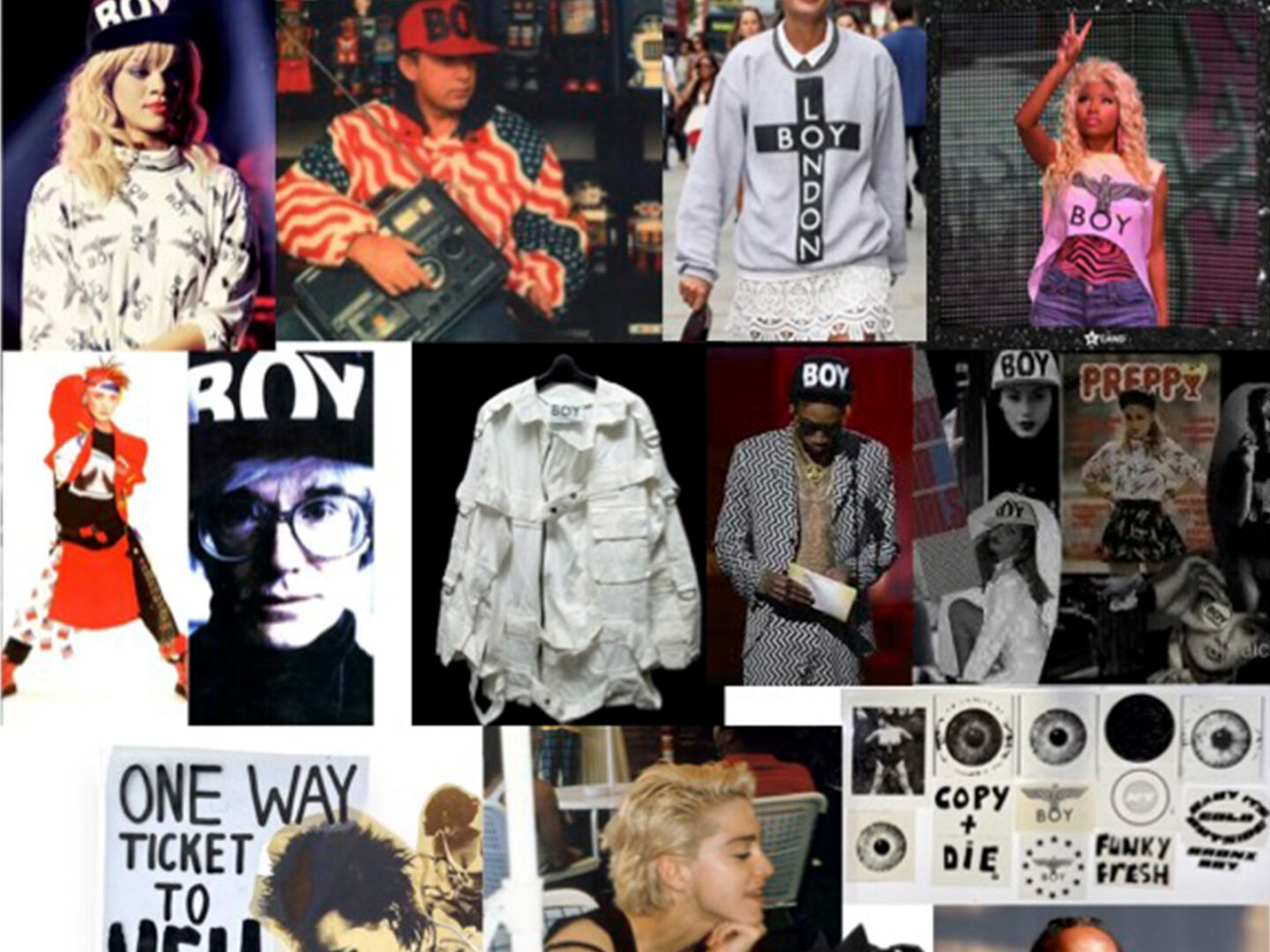
Founded in 1976 by Stephane Raynor at 153 Kings Road, BOY London was part of a scene where clothing was not just about aesthetics, but also about making a statement. Associated with figures such as Sid Vicious, Boy George, and Madonna, the brand served as a symbol within British counterculture. That spirit, according to Can Tran, the current creative director, is the starting point: reconnecting with the “original essence” of BOY, which is more closely tied to cultural provocation per se than to run-of-the-mill commercial exploitation.
The closure of its store in 1985 marked the beginning of a more uncertain period. Since then, BOY has undergone various attempts at revival, while its imagery continued to circulate independently of the product. “I don’t think BOY has disappeared entirely. It remained alive in the culture, even when it ceased to have commercial impact,” says Can Tras. But today, the context is completely different, not only for the British brand but for all those with a bit of history. The archive no longer belongs to the past but circulates freely, constantly blending and renewing its meaning on digital platforms. And that is where BOY London faces the challenge: How to approach its legacy? The designer himself states that it is, in reality, “about giving it clarity and a firm point of view once again.”
For Tran, the archive doesn’t function as something that must be preserved intact: “It is a foundation upon which to build, not a cage that limits that construction. The goal is to preserve the meaning of the symbol, not just reproduce its appearance.” This involves working from the attitude—the provocation, the tension—rather than from the exact form in which they manifested in the past.
The eagle has been the symbol that has defined BOY London’s identity for decades, both for its recognizability and for the controversy surrounding its aesthetic. Its absence in this new phase points to a possible reconfiguration of BOY London America’s visual language, in line with that constant balance between recognition and reinvention that Can Tran speaks of.
That same logic carries over into the design. There is a material update—new constructions, better fabrics—and a more contemporary approach that seeks to translate that historical language into a current context, without relying directly on its most obvious codes. We saw this clearly a month ago at the Guillotine presentation, under the name Boy London America. The FW26 collection was presented at St. Paul’s German Lutheran Church in New York. A setting steeped in symbolism for a collection that moves away from the brand’s most immediate imagery.
The concept’s origin, he explains, stems from a specific moment—No Kings Day—and revolves around an idea of rupture. The title Guillotine reinforces this interpretation: a gesture suggesting a cut, a transition, and a possible reinterpretation of the brand’s own legacy.
Far from the dominant logos or the most recognizable streetwear, the collection introduces structures, fastenings, harnesses, leather, and references that blend archival elements with an almost medieval aesthetic. Tran defines this approach as a way of drawing from the past without getting stuck in it: “I like to think we’re honoring the brand’s original spirit, focusing on the ideas and punk legacy that, in a way, got lost along the way. Rebellion and free expression are as important now as at any other time in our history, so we’re guided by them as we shape what’s to come.”
Historically, BOY London has navigated very specific scenes—from London punk to club culture, from photography to pop imagery—functioning more as a shared code than as a simple brand. In this new phase, that connection isn’t approached as a strategy, but as something that must emerge organically. The intention, according to Tran, is to work with creatives who are truly building culture, not simply amplifying an audience.
From there, the concept of community also shifts. We need to foster engagement and genuine connections within an ecosystem where brands increasingly function as cultural platforms. In fact, that’s exactly what they were in the 1980s. That’s why today the brand occupies a middle ground—between legacy and independence—from which it seeks to redefine its place in the present. The question now is whether BOY London will be understood in the current context with the same clarity—and resonance—it had at its inception.
Sigue toda la información de HIGHXTAR desde Facebook, Twitter o Instagram