The performance, the first entirely in Spanish in the history of the halftime show, turned the stadium into an explicit celebration of Latin culture. Flags from across the continent, constant references to Puerto Rico and New York, and guests such as Ricky Martin, Cardi B, Karol G and Lady Gaga, who became a symbolic accomplice on stage. Together they performed Die With a Smile, a song that, in a year marked by mass deportations and raids, took on a political significance that was difficult to ignore.
Zara on the world’s most expensive stage
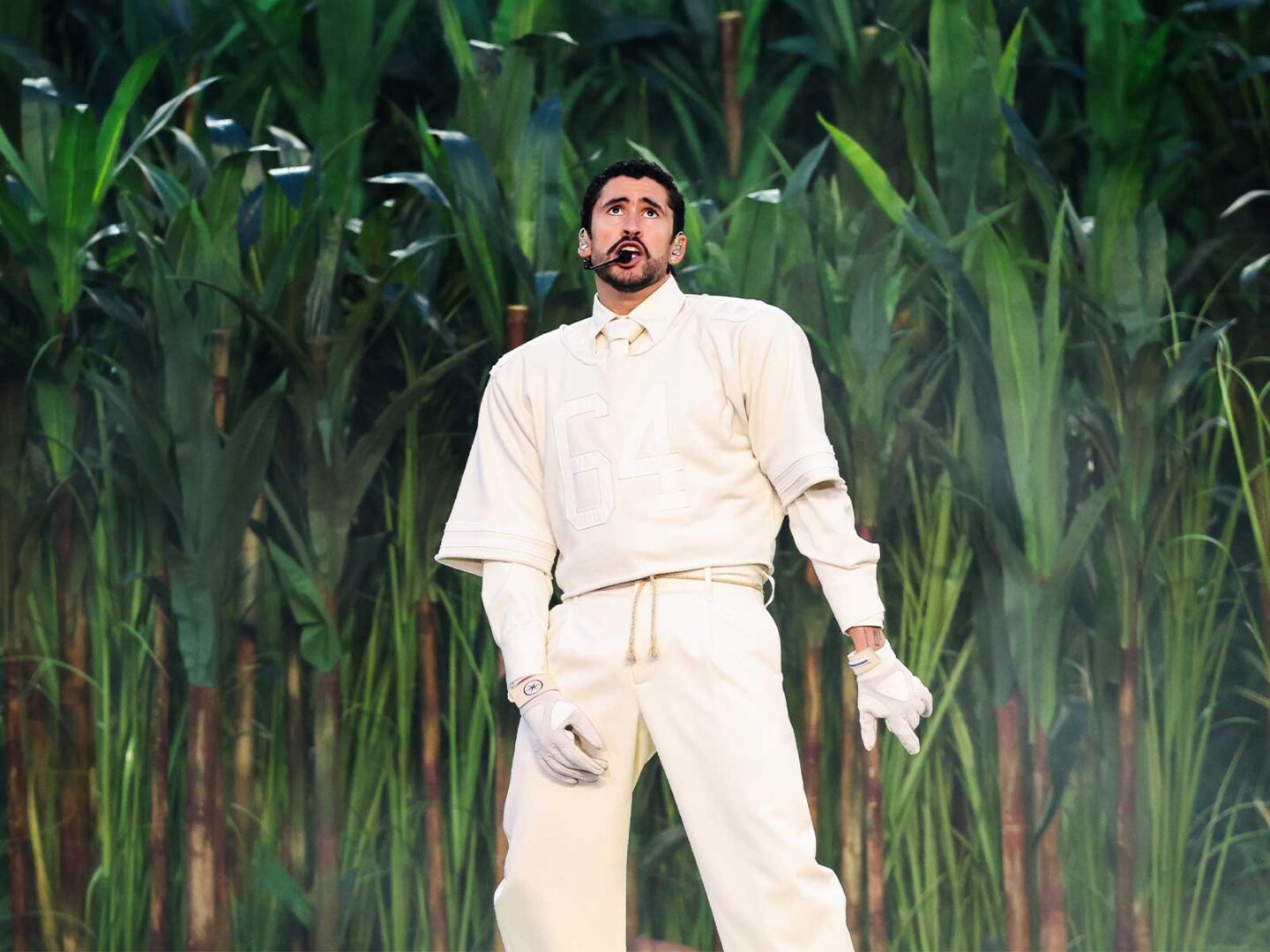
The surprise came when the artist appeared dressed in Zara. A total look in cream tones, styled by his regular collaborators Storm Pablo and Marvin Douglas Linares, consisting of a padded sweatshirt —almost linebacker style— with the number 64 embroidered on it (the year of birth of his mother, Lysaurie Ocasio), shirt with tie, chinos and trainers from his unprecedented collaboration with Adidas. Wearing Zara on the world’s most expensive stage can be seen as a legitimisation of the popular over the fetishism of luxury. But it can also be seen for what it is: a comfortable choice.
That same logic of impact extended to footwear. The Puerto Rican star took to the stage during the Super Bowl LIX halftime show wearing the BadBo 1.0 ‘Resilience,’ not yet released on the market, revealed for the first time in white, and his appearance was enough to cause a real domino effect on the internet. According to data from sneaker experts at JD Sports, Global Google searches for “adidas BadBo 1.0” increased by 496% after his performance and the pre-game press conference, reinforcing the artist’s enormous impact on international fashion trends. These are also the first trainers designed by Bad Bunny in collaboration with adidas Originals, the first version of which arrived in January 2026 in a limited edition of 1,994 pairs in brown.
The message and its paradox
It should not be forgotten that the Super Bowl is one of the biggest advertising spaces on the planet and that no brand appears there by chance. Bad Bunny’s choice of a massive, accessible, Spanish-speaking brand reinforces his message of cultural belonging: singing in Spanish, wearing a Spanish brand, speaking directly to a Latino audience of over 65 million people in the United States alone. But that same choice softens the disruptive potential of the gesture. Compared to his recent appearances with Schiaparelli, Jacquemus and Maison Margiela — where he has directly challenged gender and luxury codes — Zara fits perfectly into the system.
The styling did not entirely renounce luxury. On his wrist, Bad Bunny wore an 18-carat yellow gold Audemars Piguet Royal Oak with a malachite dial. The classic formula for today’s celebrities: appear approachable without renouncing status.
One of the most talked-about moments of the show was the appearance of Lady Gaga, dressed in sky blue with a design by Luar, the brand led by Dominican-American designer Raul López. On her chest was a red hibiscus, the national flower of Puerto Rico. The set design, which mixed references to the streets of Puerto Rico and New York, reinforced this idea of a shared diaspora.
From sweatshirt to classic heartthrob
As the performance progressed, Bad Bunny swapped his sweatshirt for a white double-breasted tuxedo jacket and wide-leg trousers. White—one of his favourite colours—connects this look with key moments in his career, such as his appearances at the Met Gala wearing designs by Jacquemus and Maison Margiela, where he has explored silhouettes traditionally associated with femininity. Here, however, white served to close the story with a polished image.
Dressing in times of tension
Bad Bunny’s Super Bowl wardrobe cannot be understood in isolation from the political climate surrounding him. Days earlier, his appearance at the Grammys in a Schiaparelli suit sparked rumours about a supposed bulletproof vest, fuelled by polarisation and then-President Donald Trump’s public criticism of his choice as the halftime show’s headliner. The rumour was false.
This context explains a central contradiction in his public persona. Bad Bunny has built his identity on aesthetic risk-taking, but his definitive entry into the centre of the cultural system now requires a more restrained approach.
Dressing in Zara can be interpreted as an appeal to the collective and the recognisable, but also as a way of avoiding friction on the world’s most expensive stage. The question left open by her look is not whether it was consistent, but whether, in a context of maximum visibility, normality remains a political act or has become the most comfortable option.
Racial debate, culture, and the Super Bowl as a mirror of what is happening in the United States.
Sigue toda la información de HIGHXTAR desde Facebook, Twitter o Instagram
You may also like...