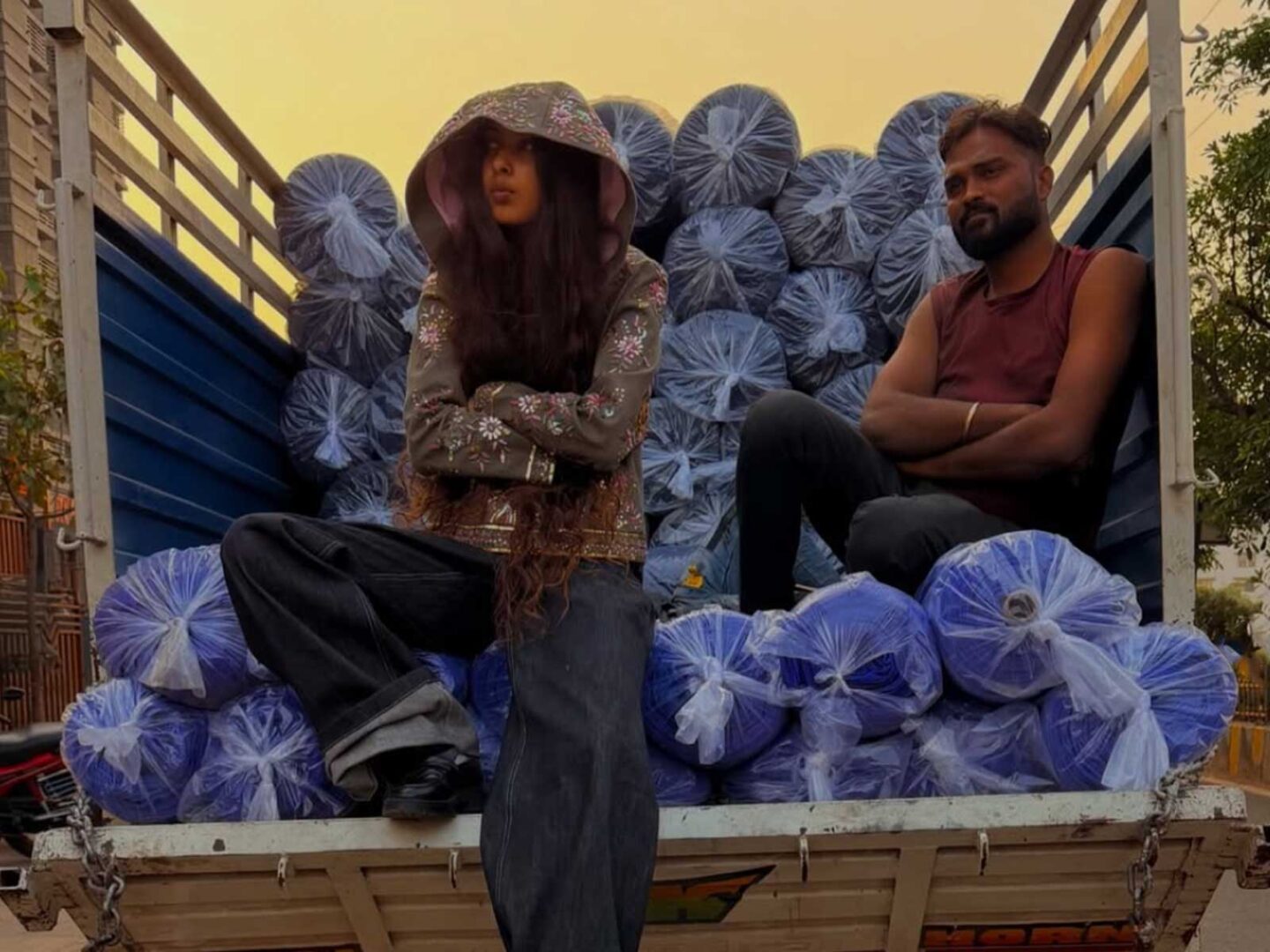
While the official fashion calendar continues to revolve around Paris, Milan and New York, a 25-year-old designer in Mumbai has proven that algorithms can be more powerful than any front row. No agency, no institutional fashion shows, no multi-million pound campaigns. Just a front-facing camera, her city and a hand-embroidered sweatshirt. That’s how Diya Joukani has managed to get millions of people to recognise her work almost overnight.
Completely self-taught, Diya began by designing the jacket she wanted to see in the world. In July 2024, she created her first piece. Since then, her brand “DIYADIYA” has grown alongside her audience, driven by reels where she models her pieces herself while going about her daily life in Mumbai. Her visual universe has become a case study in how well-understood authenticity can be more powerful than any hype strategy.
The image of a designer wearing her own clothes as she walks through the city is more magnetic than any staged scene. In her videos, Diya does what she always does. She eats at a casual restaurant, strolls among street vendors, enters a shopping centre, buys a coconut while riding a horse down the street. The difference is that she wears one of her garments, hand-embroidered using traditional techniques such as zardozi and aari. These historic techniques, associated for years with ceremonial contexts, are integrated here into relaxed silhouettes.
Visiting the DIYADIYA website is almost like watching an extension of her videos. In the description of one of her garments, Diya explains that it was originally going to be a one-off piece, but due to demand she decided to produce more. She adds technical details about the embroidery and mentions her own height as a size reference. Because Generation Z wants tangible transparency. They want to know who designs, who sews, who decides. At DIYADIYA, the distance between creator and customer is minimal.
Diya Joukani is not trying to adapt to a pre-existing system; she is building her own, where ancestral embroidery, digital culture and urban life coexist. Instead of stylising Mumbai to make it digestible, she shows it as it is: intense, noisy and contradictory. Forcing fashion to move at the real pace of the city is perhaps the most relevant aspect of her project. Her story is not just that of a viral designer, but of someone who understood that today the catwalk can be anywhere where clothes are truly lived, and that the most powerful connection is born, quite simply, from everyday life.
Learn more about her brand at diyadiya.studio.
Sigue toda la información de HIGHXTAR desde Facebook, Twitter o Instagram