While some designers refuse to play by the system’s rules, others do so on their own terms. But perhaps the question isn’t who says yes or no to certain fast-fashion brands, but why we continue to judge collaborations differently when, at their core, they work the same way.
For years—and now more so following Galliano’s hiring—there has been a widely accepted notion within the industry: working for Inditex means giving something up. Your name, your creative voice, your creative identity. A few days ago, Achilles Ion Gabriel put it bluntly on Instagram: he had turned down an offer to work with Zara. No further context was needed. The gesture was quickly understood and, in many cases, celebrated. But what’s interesting isn’t the “no.” It’s everything that happens around the “yes.”
Because while that rejection is interpreted as a decision rooted in creative integrity, we’ve spent years normalizing—and even celebrating—collaborations between designers and fast-fashion giants: Stella McCartney with H&M, JW Anderson with Uniqlo, Ludovic de Saint Sernin with Zara, and so on.
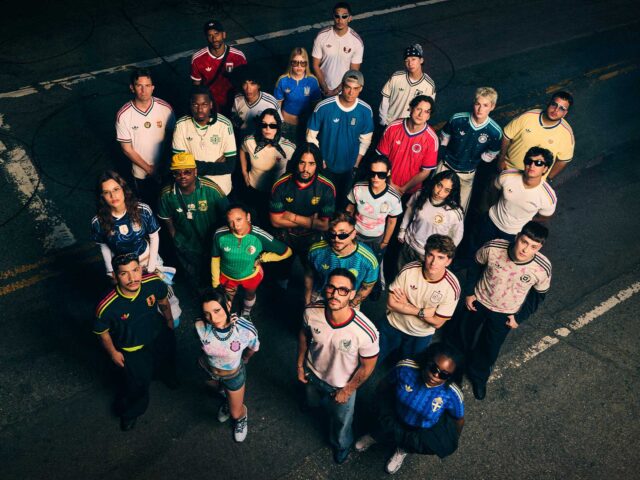
In those cases, the narrative shifts. People talk about democratization, about access, about bringing design to a wider audience. No one talks about “selling out.” No one talks about being swallowed up. And if we broaden our perspective, the contradiction becomes even more evident: Collaborations with the sports world have been fully legitimized within the industry for years. Not only that, but they’re celebrated as cultural movements in their own right. Adidas with Gucci, Prada, Willy Chavarria… Nike with Louis Vuitton, Dior, Tiffany’s, etc. Same mechanism—global scale, mass production, expanded distribution—different narrative. Because sportswear seems to have achieved something Inditex has never had: cultural legitimacy. It’s linked to the street, to music, to the archive, to performance. It has a narrative. Inditex, on the other hand, remains associated with speed, volume, and repetition. With a system where creativity seems to be diluted. And that completely shapes how we interpret designers’ decisions.
Stella McCartney has built her brand on sustainability and environmental ethics. And yet, she has collaborated with H&M. But why, then, would a designer like her choose to succumb to fast fashion? To amplify her message? To reach a mass audience? For money? A structural contradiction? A gray area?
It’s no coincidence that the collaboration between Willy Chavarria and Zara has been announced now. It’s no longer just about “invisible talent,” but about the visible authorship of a designer with a clear political and cultural voice who has decided to enter the mass retail circuit without, in principle, giving up his identity. But then again, he’s already succumbed to Adidas in the past. So does it really matter if it’s Adidas or Zara?
So the question is no longer whether it’s right or wrong to work for Inditex. The question is why we continue to judge differently decisions that, in essence, work the same way. Because perhaps the problem was never the system, but the narratives we’ve chosen to legitimize.
Sigue toda la información de HIGHXTAR desde Facebook, Twitter o Instagram
You may also like...