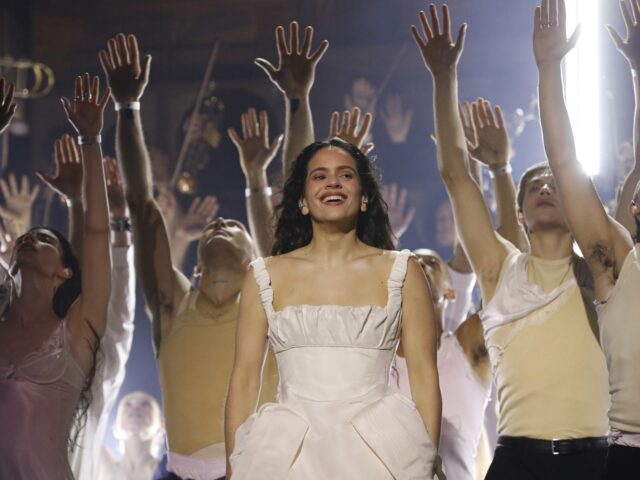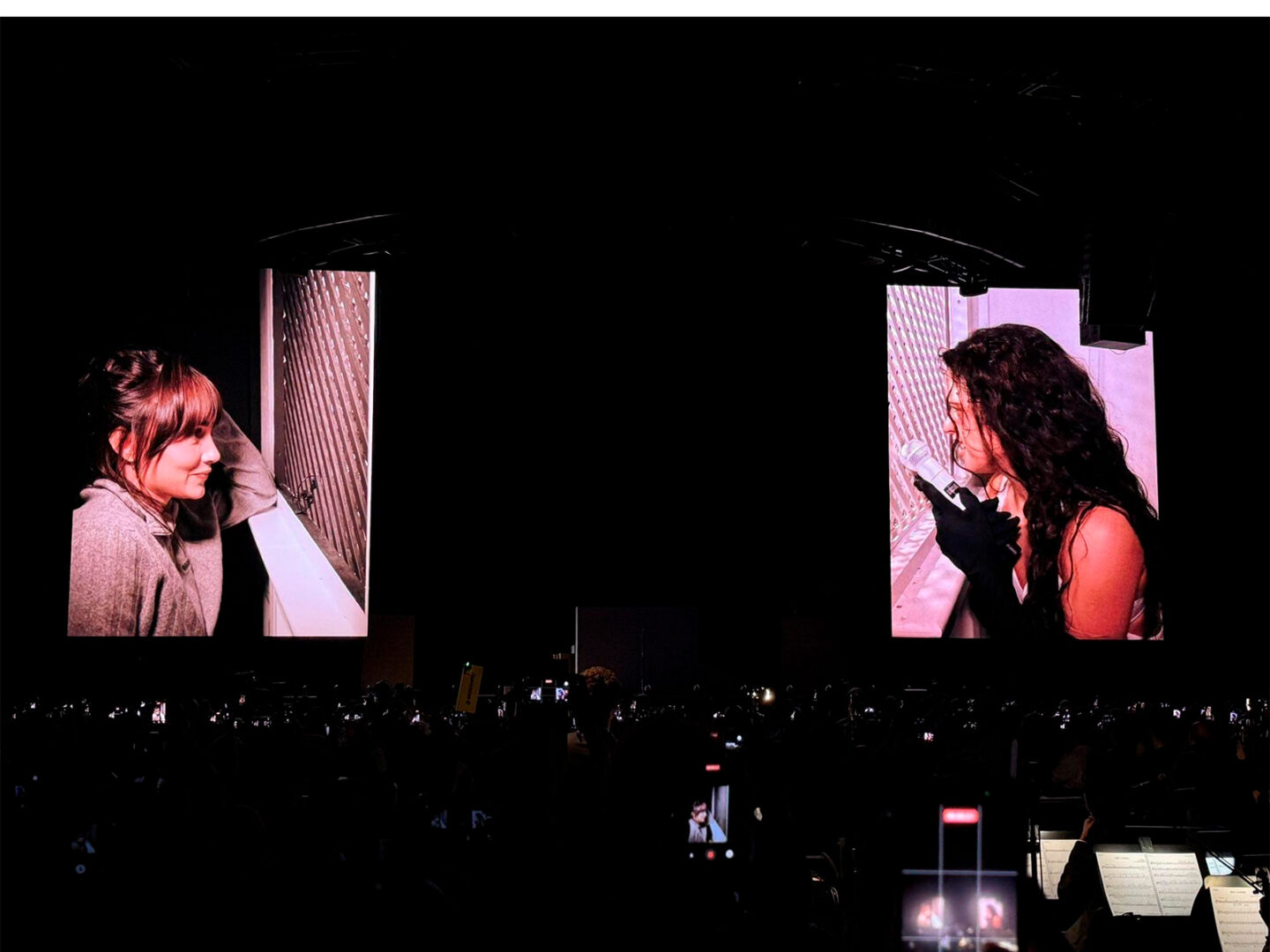
Rosalía’s confessional on her LUX Tour has become one of the most viral and talked-about highlights of every concert, gathering confessions of heartbreak, awkward stories, and moments that live on beyond the live performance—on social media and in the news. What began as a simple emotional prelude to *La Perla* has ended up being a space where the intimate becomes a spectacle and where the personal is elevated to a collective narrative.
Far from being random, the casting for the confessional paints a fairly precise picture of the cultural moment we are living in. From Aitana to La Pringada, from Bad Gyal to Rojuu, Rosalía has been building, city by city, a kind of emotional collage where different generations, codes, and sensibilities coexist.
That is why the format ceases to be a simple interlude and becomes a tool for social discourse. Because Rosalía isn’t just listening to stories. She is deciding through which stories she tells her own narrative. Let’s review:
Soy Una Pringada: The First Confessional and the Most Unexpected Choice
Con Esty Quesada (@soyunapringadalol), Rosalía unleashes the element of surprise. She chooses a figure historically situated on the margins—freak, queer, non-conforming—and places her at the center of the mainstream scene. Rosalía isn’t afraid to make people uncomfortable on a massive scale with the bizarre love story told by Esty; in fact, she seems to enjoy it. Plus, she had to return the favor after Esty’s appearance on the podcast.
Metrika: The Founding Mother Speaks Out
Inviting Metrika, the founding mother, means deliberately choosing one of the most radical voices—both aesthetically and in terms of discourse—on the music scene. Rosalía chooses to push the boundaries of her own universe to connect with Gen Z. Here, she positions herself as a bridge between generations, but also as a filter: the new passes through her, she blesses it, she gives it her seal of approval.
A few days later, incidentally, Metrika herself walked the runway alongside Carmen Lomana for Dominnico.
Aitana: Superstars face to face
With Aitana, the narrative thread is one of juxtaposition. Rosalía, after serving as the voice of two radical movements, proves that she can also inhabit the absolute mainstream without losing credibility. It’s an almost surgical balance: one underground, one mainstream. But there’s something even more interesting: she turns that space into a place where even the most media-controlled figures can afford to show cracks—like talking about Sebastián Yatra—and even allow herself to say, “It’s just that singers always make… statements. What they call statements,” reflecting on what she perhaps experienced with Rauw. So here, Rosalía doesn’t just share the spotlight with Aitana; she redistributes it to all the superstars, doesn’t she?
Shannis: The Queer Voice
Shannis’s appearance functions perhaps as a political gesture, yes, but also as a narrative integration of all the voices that have suffered at the hands of a Perla. All within the same framework as the rest of the stories that have passed through the confessional. That’s the key. Rosalía doesn’t separate the dissident, but rather incorporates it into her universe and, through that, also reformulates her own discourse. And that, in terms of pop culture, is far more effective than any explicit statement.
Yolanda Ramos: A Champion of Traditional Comedy
Now in Barcelona, Rosalía kicks off her concert series in the Catalan capital by inviting Yolanda Ramos. Doing so is a nod to a very specific cultural lineage: absurd, domestic, deeply Spanish humor. From Paquita Salas to HomoZapping, there’s a thread connecting that cultural imagination to Rosalía’s more performative side. Here lies an emotional connection, as well as a nod to other generations of fans.
Guitarricadelafuente: A Gem in a Gay Relationship
With Guitarricadelafuente, Rosalía introduces an intimate narrative that connects directly with the gay audience. From the vulnerability inherent in those first experiences, a very real sense of closeness is built: that of someone who not only represents a community but also accompanies and understands the journeys of the people who make it up.
Bad Gyal: Zero Rivalry
The meeting with Bad Gyal debunks one of the industry’s favorite narratives, one still dominated by men: rivalry among women. Two parallel careers, two distinct aesthetic worlds, and yet, zero friction. Rosalía not only avoids conflict—she actively defuses it. And along the way, she and Alba weave a discourse on the body and others’ judgments without needing to preach.
Rojuu: “I am The pearl”
With Rojuu, the format takes a 180-degree turn: by declaring herself “the pearl” of her own story, acknowledging that the situation was too much for her, and asking for redemption rather than validation, she introduces a layer of self-criticism, shifting the focus from drama to emotional responsibility. Here, Rosalía changes the tone of the format. Until now, the confessional served as a megaphone for betrayals, disappointments, or absurd situations. With Rojuu, another narrative emerges: that of repentance. The acknowledgment that you, too, can be the problem.
In the end, the confessional serves as something far more precise than just a moment within the show: it’s a way to take a stand without having to explain herself. Rosalía doesn’t give speeches, but she doesn’t need to either. All she has to do is choose carefully who she seats in that chair to make it clear where she’s standing right now. Between the uncomfortable and the mainstream, the intimate and the viral, the queer and the traditional, Rosalía doesn’t seek to fit into a single place, but rather to demonstrate that she can inhabit them all, and that she can navigate that contradiction without apparent friction. And perhaps that is the key: in embracing constant change as her own language. She said it herself in those verses from Saoko—“I contradict myself, I transform myself, I am a butterfly, I transform myself, I am all things, I transform myself”—almost like a manifesto. The confessional is nothing more than another extension of that idea: a space where she doesn’t fix an identity, but rather shifts it, tests it, and rewrites it in real time.
Sigue toda la información de HIGHXTAR desde Facebook, Twitter o Instagram
You may also like...