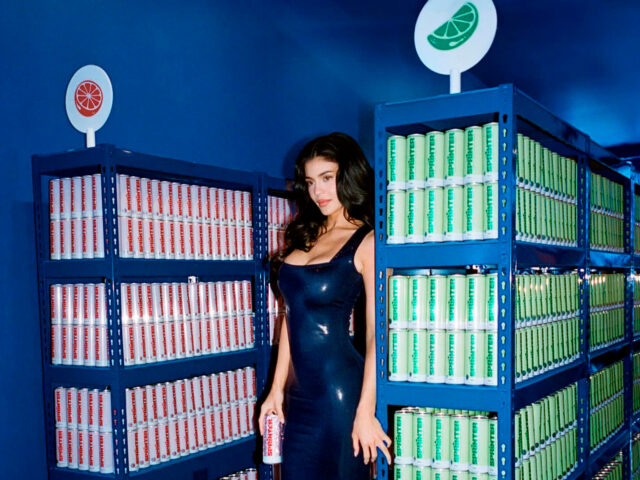
The influencer—that major internet star of recent times. We don’t just know what they’re wearing—we know their partner, their home, where they spend their vacations, what they eat for breakfast, when they’re getting married, when they break up with their partner, and what moisturizer they use before bed. We’ve gone from the “fit pic” in front of the mirror to “get ready with me,” then to “a day in my life,” and finally to spending entire days with complete strangers during which, more often than not, absolutely nothing happens. Other people’s private lives have become
But now something has changed: we’re still watching, but we’re starting to question who we’re watching. This summer, “unfollowing” has become almost a sociopolitical statement—or at least a mirage of one. Racist comments, complaints about taxes, conspiracy theories, and vacations that have turned into seemingly unbearable workdays have ultimately crystallized into a much broader conversation about privilege and the disconnect some people have from real life. The internet, which, like them, has never had much patience for the nuances and details of the phenomenon, has given it a definitive name: the fall of the influencers.
The media, too, were quick to buy into this assessment—at least partially. In August, El País asked whether “influencers die by their own words,” and a few days later spoke of their “first major crisis.” La Vanguardia, less willing to declare them dead, responded with “The (Non) Decline of Influencers.” Meanwhile, Reuters observed how brands are beginning to turn to smaller profiles in search of specific communities and something that seems to have become scarce: credibility.
Translated with DeepL.com (free version)
Declaring the death of the influencer is very premature because the reality is that the business isn’t actually dying—quite the opposite. Investment in influencer marketing in Spain reached 158.4 million euros in 2025, up 25.9% from the previous year, according to data from IAB Spain and PwC. In the United States, social media creators’ earnings could reach $21 billion this year—a 16% increase from 2025—according to Reuters. In other words: while the internet is symbolically organizing their funeral, brands are still footing the bill. So, what is really on the decline when it comes to influencers?
For years, the distance between influencers and their followers was precisely part of the appeal. Bali on a Tuesday, a hotel suite on a Wednesday, a handbag before it hit the stores, and a SMEG refrigerator filled with drinks arranged by color. This lifestyle created a reality close enough for us to recognize ourselves in it, yet far enough away to make us long for it. But something happens when that distance ceases to be perceived as an aspiration and begins to be seen as a privilege.
Influencers didn’t invent inequality, but they did create a unique vantage point from which to observe it. The elite have always had better homes, vacations, and access; what’s new is following them from the moment they wake up until they go to bed. We see the business, the hotel, the gifting, and the handbag that just arrived. We see how much someone who could probably afford it receives for free. And we also see their complaints. Privilege didn’t start with Instagram. What’s new is being able to see it in Stories on the way to the office.
Let’s think of an influencer’s wedding as something that perfectly highlights this contradiction. People with enough financial means to pay for a celebration that is out of reach for a large portion of their followers may end up having it practically for free in exchange for turning it into content. The dress, the flowers, the catering, the hotel, and the honeymoon all fall within an economy where the currency isn’t necessarily money, but exposure. The greater your visibility—and often your spending power as well—the more things you can get for free.
The paradox is hard to ignore: the person who could most afford to buy it is also the one most likely to receive it for free. But there’s a catch. To get it, you have to turn what was once a private matter into advertising fodder. The wedding is no longer just a wedding: it’s also a stage, a campaign, a showcase, and content. We’re not simply looking at a privileged life on display online, but at a life whose privilege increases precisely because it’s on display.
That’s where Andrea Hest’s reflection on class takes on a new dimension. “Some influencers are a new bourgeoisie, even a new nobility, but with the difference that we see everything about them all the time,” she said recently. “Many influencers have turned the system’s culture of aspiration into a business.”
For a long time, that business operated through a kind of implicit contract between both sides of the screen: you show me a different life, and I give you my attention in return. The follower was never really a free spectator. They paid with time, views, interaction, and, ultimately, consumption. That attention indirectly funds what later returns to the screen, transformed once again into aspiration.
The crack appears when we start to see all too clearly the infrastructure that underpins the fantasy. We know that a trip might be a press trip, that a dress might be a gift, and that behind a statement like “I have to show you this because I love it” there might be a briefing, rounds of approval, and an invoice. According to AIMC, 69.8% of internet users surveyed believe there is use or abuse of covert advertising among influencers, and 61.9% believe that most of their posts are promotional in nature.
But there’s one key difference compared to Instagram’s early years: advertising can no longer so easily masquerade as something else. The General Audiovisual Communication Law prohibits covert audiovisual advertising, and the CNMC has tightened the criteria for how it must be identified on social media. For creators subject to this regulation, it’s not always enough to include a #ad buried in the caption, call themselves a brand “ambassador,” or use Instagram’s “collaboration” tag: the advertising nature must be clear within the audiovisual content itself, with explicit labels such as “advertisement” or “ad.”
And the authorities have already started knocking on the door. In June 2026, the CNMC issued notices to Sofía Suescun, Tamara Gorro, Peldanyos, Samy Spain, and Lola Lolita regarding posts on Instagram and TikTok that did not properly identify their commercial nature. These were not fines—the content predated the establishment of the current guidelines, and the CNMC opted to issue compliance notices—but the message is quite clear: the line between a recommendation and an advertisement can no longer depend solely on how long it takes the user to realize they’re being sold something.
The case of Lola Lolita also raises an even more interesting question. She and the brand argued that a post was not advertising because it had not been paid for and was not included in a contract. The CNMC, however, ruled that a commercial purpose could exist even in the absence of direct payment. This distinction is particularly relevant in an industry built around gifting, travel, invitations, and access: the absence of an invoice does not necessarily mean there is no exchange of value.
And perhaps that’s part of the problem. For years, influencer advertising worked precisely because it didn’t look too much like advertising. It was a recommendation slipped in between a breakfast post, a vacation photo, and a video in front of the mirror. Now we understand the language, we understand the business, and even the law requires us to reveal the seams. The aspiration is beginning to reveal its underlying structure all too clearly.
The context from which we view things has also changed. A complaint about working during paid vacation time is received differently by someone working split shifts; constant outrage over taxes sounds different to someone who spends a large portion of their salary on rent. Not because the creator can’t get tired or frustrated, but because the closeness upon which they built their power makes it impossible to hide the distance. Herst speaks of “disloyalty.” Perhaps it’s another way of describing the breakdown of the aspirational contract.
But that promise was never solely economic. The Internet also democratized something that, until then, had belonged primarily to celebrities, artists, or historical figures: the possibility of building a massive archive of our existence. We used to leave behind photo albums; now we leave behind a feed. Influencers took that logic to its ultimate expression: living and producing evidence of being alive ended up becoming practically the same activity.
Psychology has spent decades studying our need to construct symbolic mechanisms that give meaning and continuity to an existence we know to be limited. The Internet offered a particularly alluring one: documenting everything. A birthday, a trip, our bodies, a relationship, a breakup, a new home. Everything remains stored even as we move on. “We’ve never had so many tools to leave our mark, and at the same time, it’s never been so obvious how easy it is to be replaced,” notes Marina Ordax.
Therein lies another of the internet’s great contradictions: it promised us permanence while building a machine based on constant replacement. Every day it needs a new face, a new video, a new aesthetic, a new microtrend. The archive remains; attention moves on. Warhol imagined that in the future, everyone would be world-famous for fifteen minutes. The internet fulfilled that prophecy and added a little twist: when your fifteen minutes are up, there are millions of people waiting to take your place.
And the platforms themselves have accelerated this shift. There was a time when going online meant choosing who we wanted to watch. We’d subscribe to a YouTube channel and come back when there was a new video. We’d open Instagram and find the accounts we’d decided to follow. First we chose the person, and then we consumed their content. The vertical format, however, reversed that order. TikTok, Reels, and Shorts perfected an infrastructure where we open the app and the content simply unfolds. One face replaces another with the swipe of a thumb, and we can spend forty minutes watching dozens of people without remembering the name of practically any of them afterward. We’ve gone from following people to consuming content.
In a video recently uploaded to one of his YouTube accounts, Nil Ojeda compares that vertical scrolling to walking into a casino: an endless succession of stimuli in which every movement promises another small reward. View counts can skyrocket, but turning those seconds of attention into a relationship is much more complicated. A video can get ten million views without creating ten million connections. The long-form format retains something that scrolling makes difficult: intention. To watch a forty-minute video, you have to choose it, click on it, and stick with it.
Perhaps we’ve been confusing reach with influence for too long. The difference lies between being seen and being remembered. And the more obsessed the industry becomes with deciphering the algorithm, the more similar the content begins to look: the same hook, the same editing, the same audio, the same story told by twenty different people. “When we talk about the algorithm, we’re really just talking about people,” Ojeda points out. The algorithm detects what we pause, share, save, or discard. But when creators stop asking themselves what they want to tell and start asking what they need to post to succeed, another contradiction arises: the more content they churn out to please the algorithm, the more replaceable they become. That’s why, perhaps, the truly scarce resource on the internet is no longer getting attention—it’s getting someone to come back.
While culturally we’re debating a downturn, within the industry the talk is more about professionalization. María Cordero, founder of TWIC and with 17 years of experience in talent representation, said in an interview she gave to ac2ality last week that she’s been hearing the same question for practically all that time: how long is this going to last? So far, the numbers have spoken for themselves.
Some creators have evolved into full-fledged business entities with their own brands, audiovisual projects, and business development initiatives. And brands have also learned that bigger numbers don’t always mean greater impact. Community engagement, credibility, and brand value are becoming increasingly important. The irony is quite telling: after building an industry obsessed with quantifying influence, we’re now trying to go back to measuring something as old as whether people believe you.
Professionalization also debunks another oversimplification of what’s happening. Cordero explains that creators work “24 hours a day in their heads” and that, after years of managing talent, he’s more concerned about frustration than ego: the constant comparison with others’ numbers, campaigns, trips, and opportunities. The follower may think the influencer doesn’t work, and the influencer may feel like they never stop working. Both perceptions can coexist. And here, the machinery of aspiration comes full circle: while the follower looks up to the influencer, the influencer is also looking up to someone else. Aspiration doesn’t disappear when you make it to the other side of the screen. It simply finds someone else to look up to.
That’s why reducing this whole phenomenon to a “decline of influencers” is far too simplistic. We haven’t stopped consuming content, brands haven’t stopped investing, and we haven’t stopped buying things just because we see them online. We can unfollow someone and still be influenced; laugh at a press trip and still want the bag featured in it; spot a sponsored post a mile away and still end up searching for the product; stop admiring a particular personality and find the very thing they were selling twenty minutes later in someone else’s video. Because influence no longer necessarily requires an influencer. It has fragmented:
A pair of shoes appears twenty times, a restaurant thirty, a destination dominates our feed for a week, and a certain aesthetic is repeated hundreds of times until we start craving it without remembering exactly where we first saw it. Influencers, micro-creators, celebrities, friends, brands, and complete strangers all play a part in shaping our desires at the same time. We had never been so influenced, and perhaps it had never mattered so little who first began to influence us.
The industry will likely continue to grow, become more professional, and find new ways to turn attention into money. What seems to be running out is a certain internet fantasy: that being visible meant mattering, that accumulating followers meant having influence, and that behind every large audience there had to be someone we knew, followed, and admired. We don’t even need more than fifteen minutes anymore. Fifteen seconds, a vertical format, and autoplay are enough for us.
Sigue toda la información de HIGHXTAR desde Facebook, Twitter o Instagram
You may also like...